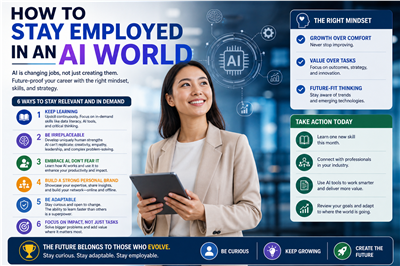
The headlines have been hard to ignore. In April 2026, a City Hall report found that more than two million Londoners are in roles where generative AI could automated a chunk of their daily tasks. Nationally, figures from Coface put the UK ahead of every other major economy for AI exposure — around a fifth of all tasks performed by British workers are now within reach of automation. That’s a higher proportion than in the US, Germany, or Australia.
It would be easy to read all of this and feel like the ground is shifting beneath your feet. For many people, it genuinely is. But the picture is more complicated than the doomsday framing suggests — and understanding it properly is the first step to doing something about it.
Who’s Actually at Risk
Not all jobs face the same threat, and it’s worth being clear-eyed about where the pressure is concentrated.
The roles most exposed right now are those built around structured, repeatable tasks performed through a screen: administrative work, data entry, back-office processing, customer service, basic copywriting. According to the IPPR, secretarial, customer service and administrative roles are at the sharpest end of the first wave of AI adoption. In the UK specifically, bookkeepers and wage clerks face automation risks of around 94%, with bank clerks close behind.
Younger workers and women are disproportionately affected, largely because they’re overrepresented in exactly these kinds of roles. The British Chambers of Commerce has flagged growing concerns about youth unemployment as AI accelerates — partly because employers are reducing entry-level hiring at the same time as the cost of employing people has risen sharply due to NIC changes and National Minimum Wage increases.
At the other end of the spectrum, jobs requiring physical presence, hands-on judgement, and in-person human contact are proving far more durable. Roles like electricians, plumbers, childminders, district nurses and care workers are consistently rated as low-risk. There’s also the curious case of chief executives and senior leaders, who show up in the “least at risk” category — partly because the social and legal accountability attached to those roles acts as a natural brake on full automation.
The honest truth, though, is that almost nobody’s job is completely untouched. The question isn’t really “will AI affect my work?” It’s “in what way, and how quickly?”
The Difference Between Being Replaced and Being Reshaped
BCG’s 2026 research found that 50–55% of jobs will be reshaped by AI rather than replaced outright. Only 10–15% face elimination over the next four to five years. That distinction matters enormously, because it changes what you should actually be doing about it.
Being reshaped means your job title stays the same but the tasks within it shift. The routine, processable parts get handed to AI. The parts that require contextual judgement, client relationships, creative problem-solving, and accountability stay with you. In theory, this should make work more interesting. In practice, it also means that people who resist that shift are likely to find their value diminishing over time, while those who lean into it position themselves well.
A March 2026 analysis in The Conversation put it plainly: the most resilient path forward is rarely about abandoning your field entirely. It’s about layering AI fluency on top of existing expertise. A finance professional who understands how to use automation tools is better positioned than one relying on legacy skills alone — not because they’ve become a technologist, but because they’ve moved closer to the decision-making layer of their work.
What “AI Fluency” Actually Means in Practice
This phrase gets thrown around a lot, but it’s worth unpacking. AI fluency in 2026 doesn’t mean learning to code or training machine learning models. Think of it the way people once thought about basic computer literacy in the early 2000s: not everyone needed to understand how a database was built, but everyone needed to be able to use one.
At a practical level, AI fluency means:
Knowing what the tools can and can’t do. AI is excellent at processing large volumes of structured information, drafting first versions of documents, summarising data, and generating options. It struggles with nuance, genuine novelty, ethical judgement, and anything requiring real-world physical context. Knowing this boundary — and being the person who sits on the right side of it — is increasingly the value you bring.
Being able to direct AI effectively. The quality of what you get out of any AI tool is directly tied to how well you can articulate what you want. This isn’t some niche skill reserved for “prompt engineers”; it’s becoming part of how competent professionals work. Learning to structure a brief, provide context, and critically evaluate the output rather than accepting it wholesale is simply good practice now.
Integrating tools into your actual workflow.Many workers already have AI capabilities sitting inside tools they use every day — in Microsoft 365, Google Workspace, their CRM, their accounting software — and aren’t using them. Familiarity with these isn’t optional much longer.
Demand for AI and machine learning skills in the UK has surged by 245% since 2023, according to Cornerstone’s 2026 Skills Economy Report. That doesn’t mean 245% of the workforce needs to become AI specialists. It means that across almost every field, employers are increasingly looking for people who can work intelligently alongside these tools.
The Skills That Are Actually Getting More Valuable
As AI handles more of the routine cognitive work, human capabilities that were always important but often underused are moving to the front.
Critical thinking and contextual judgement. AI can answer well-defined questions quickly. It’s still poor at working out which questions to ask in the first place, or at recognising when a situation doesn’t fit the standard pattern. The ability to apply real-world context to information — to know when the data is telling you something misleading — is proving more valuable, not less.
Communication and interpersonal skill. Client relationships, difficult conversations, negotiation, team leadership — these are genuinely hard to automate, not because AI couldn’t produce plausible-sounding words, but because the social stakes are real and people notice the difference. Emotional intelligence is flagged consistently as one of the more durable professional assets.
The ability to keep learning. The Pearson Lost in Translation report suggests that around 65% of the skills needed for existing jobs will have changed by 2030. The specific knowledge you hold today is less durable than your ability to acquire new knowledge quickly. Treating your own development as an ongoing practice rather than something you completed in your twenties is, for many people, the most important shift to make.
Domain expertise combined with technical literacy. This combination is the sweet spot. An experienced nurse who understands AI-assisted diagnostic tools is far more valuable than either a nurse who ignores them or a technologist who doesn’t understand clinical practice. The same principle applies across law, marketing, construction, education, and most other fields.
The Trades Boom — and What It Tells Us
Something unexpected has happened in the UK jobs market over the past year or so. Gen Z workers are increasingly choosing skilled trades. In construction and trade roles, hiring of workers born after 1997 rose by 16.8% in the year to January 2026. Some commentators have taken to calling this the “toolbelt generation.”
The logic is straightforward: if you’re worried about AI disruption, go somewhere AI genuinely can’t follow. Plumbing, electrical work, gas installation — these require physical presence, manual dexterity, situational judgement and genuine problem-solving in uncontrolled environments. Fewer than 10% of tasks in most trade roles are automatable. And with years of underinvestment in vocational training, demand for skilled tradespeople is strong and wages are rising.
This isn’t a path that suits everyone, and it shouldn’t be read as a general solution. But it does illustrate a broader principle: the closer your work is to the physical world, to direct human relationships, or to complex real-time judgement, the more insulated you tend to be.
What Employers Are Actually Doing
It’s easy to talk about this from the worker’s perspective, but it’s worth understanding what’s happening inside organisations too.
The BCC’s latest research shows that 54% of UK SMEs are now using AI tools — more than double the figure from 2024. But among those businesses, around 28% say they are focused on retraining existing staff rather than cutting jobs. Only about 5% say they’ve reduced overall headcount directly because of AI so far, though 17% expect their workforce to shrink during 2026.
The message for workers is that most employers, at least for now, are trying to adapt rather than replace. That window won’t stay open indefinitely, but it does mean there’s a reasonable chance that if you demonstrate willingness to develop and adapt, your employer has a reason to invest in you rather than restructure you out.
It’s also worth noting that the government isn’t standing entirely still. The AI Opportunities Action Plan, the London AI and Jobs Taskforce chaired by Baroness Lane-Fox, and various Digital Skills Council initiatives are all part of a policy response that’s still taking shape. These aren’t reasons to be passive — they’re reasons to be aware of what support and retraining options may become available.
A Practical Starting Point
If you’re trying to work out what to actually do, rather than just reading about it, a few things are worth considering:
Audit your current role honestly. Which parts of your job involve structured, repeatable tasks? Which involve judgement, relationships, or physical presence? The former are where you should expect change; the latter are where you hold ground.
Pick up AI tools without waiting to be asked.Experiment with what’s already available in your current tools. Use AI to draft things, then edit them. Use it to summarise things, then interrogate the summary. The goal is to develop an informed view of what it can and can’t do in your context — which is more useful than any course.
Invest in the skills that compound.Communication, leadership, critical thinking, and the ability to learn are valuable precisely because they transfer across roles and fields. They compound over a career in a way that any specific technical skill doesn’t.
Don’t wait for your employer to train you.Many will. But the workers best placed over the next five years are the ones treating their own development as a personal responsibility, not something that happens to them.
The AI era is not, in the end, a binary choice between keeping your job and losing it. It is — as The Conversation put it in March — about positioning. Most people who find themselves well-employed in five years won’t have escaped AI’s reach. They’ll have moved closer to the parts of their work that remain irreducibly human, while becoming more capable of directing the parts that don’t.
That’s a harder problem than learning a single new skill. But it’s also a more honest description of what’s actually required.
Sources: UK Government assessment of AI capabilities and the labour market (January 2026); IPPR report on UK jobs and generative AI; City Hall London AI and Jobs report (April 2026); British Chambers of Commerce AI and SME research (March 2026); Coface/OEME occupational analysis (April 2026); BCG 2026 workplace research; The Conversation (March 2026); Cornerstone 2026 Skills Economy Report.